Tonight’s program.
- 01Welcome & IntroductionJim Parys · Moderator, Team Lead for Home Rule
- 02Why We’re HereNick Little · President, Niwot Incorporation Committee
- 03Niwot TodayBiff Warren · Niwot attorney and 50-year resident
- 04Meaning of Home Rule & Municipal CharterKevin Bommer · Executive Director, Colorado Municipal League
- 05Boulder County: What Changes, What Stays the SameScott Firle · Boulder County Leadership Fellows graduate & 12-year Niwot resident
- 06Election & Charter Commissioner ProcessLois Adamson · Chair, Election Commission
- 07Conclusion & TimelineHeidi Storz · Former President, Niwot Community Association
- 08Questions & AnswersOpen floor
A group of your neighbors.
- All volunteer. Our job is to help residents understand what incorporation and home rule mean.
- Funded by Niwot. Donations and loans from residents cover court filings, professional fees, election commission costs, the ballot bond, and education and communications.
- Cross-partisan. Republicans, Democrats, and unaffiliated — not by design, just how the committee came together.
- Not developers. Nobody on this committee stands to profit from what we’re proposing.
- We live here — and we’ve been here. Kids in local schools, businesses downtown, years of Niwot volunteering behind each of us.
What we share is a sense that Niwot deserves to be stewarded by the people who live here.
No road funding.
No seat at the table.
Higher minimum wage than our neighbors.
The county tightened what you can build on your own land.
Boulder business stayed lit. Niwot went dark.
Five symptoms of one problem.
We have no political agency in our own community. Every pressure you just heard traces back to the same thing — Niwot’s future is decided in rooms where Niwot has no seat.
Home rule incorporation gives us that seat — inside the system we already live in.
Platted 1875. Never incorporated.
- County commissioners. Three, elected countywide. They decide our zoning, ordinances, and priorities.
- County departments. Land use, public works, and the sheriff — all administered at the county level.
- Advisory bodies. The Niwot Design Review Committee has a voice on downtown development, but no vote. Niwot Rural Community Districts I & II rules adopted by the county determine downtown development.
- Special districts. The LID and Burgundy Park PID fund limited local improvements.
- A seat without a vote. Niwot sits on the Boulder County Consortium of Cities — but only incorporated towns vote. Communities smaller than Niwot vote there because they’re incorporated.
Open space by design. Incorporation doesn’t change it.
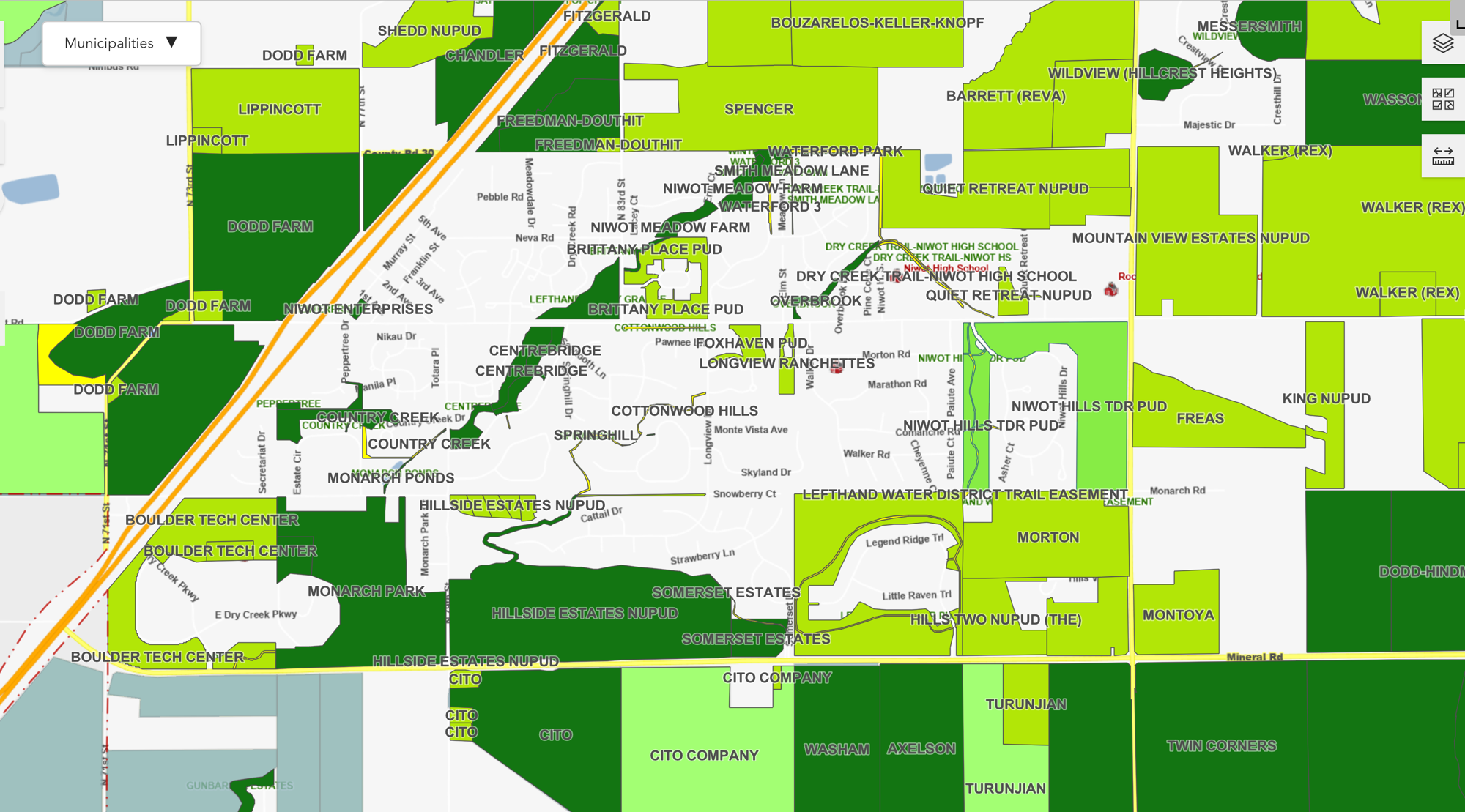
73 Transferable Development Rights, granted through a 1980s-era Boulder County program, arranged for permanent open space to surround Niwot. Conservation easements and county open space combine to protect Niwot — and incorporation does not change any of it.
Niwot’s nonprofits.
Two dozen organizations already carry Niwot on their shoulders. Incorporation adds municipal tools; it does not replace civic life.
This is not a new problem.
Different decisions. Same structure. Niwot could petition. Niwot could not act.
The road bill is coming no matter what.
Same road bill. Smaller ask. Deferring the fix is a hidden tax.

Founded in 1923, CML is a nonprofit, non-partisan organization representing and serving Colorado’s cities and towns. Our membership consists of 270 municipalities, representing nearly 100% of the municipal population in the state.
The League advocates on behalf of municipal interests at both the state and federal levels and is also a reliable source of training and information for municipal staff and elected officials across Colorado. CML’s policy focus areas are approved by the CML Executive Board and developed with input from our diverse membership. A staff of 17 carries out daily operations, guided by a comprehensive strategic plan that informs key priorities and goals that support the League’s mission, vision, and values.
- Advance and defend municipal interests at the state and federal levels.
- Provide expert municipal legal services to support CML members.
- Empower members to be leaders on municipal issues and advocate for CML policies and positions.
- Be the leading statewide information resource on municipal issues.
- Provide quality opportunities for meaningful member interactions.
- Provide innovative and personalized training and outreach opportunities.
- Implement a robust communications and training plan focused on engagement.
- Increase the resources available for municipal staff and elected officials.
- Collaborate with partners to maximize resources and increase efficiency.
- Envision the future needs of CML and member municipalities.
- Support the development of leaders within municipalities.
- Inspire participation in CML by elected officials and staff.
- Promote principles of good governance and civic dialogue.
Considerations.
The source of home rule authority.
Municipalities lacking home rule status are limited to exercising the powers granted by the state. Home rule municipalities derive their authority from the state constitution itself.
The charter is an instrument of limitation.
Under Colorado law, the charter sets forth the basic:
- Structure and organization of government.
- Procedures to be followed by municipal government in the conduct of its business.
- Powers of municipal officials and agencies — including any limitations.
The charter does not spell out the details of operations. Details are left to the governing body. State law applies in the absence of a charter or ordinance provision.
Niwot would be Colorado’s 274th municipality.
Depending on outcomes, Niwot could become the 109th or 110th home rule municipality in the state (contingent on Cripple Creek’s charter vote in November).
Core municipal functions.
- Form of Government. Who serves. Who runs day-to-day operations.
- Elections. Who’s elected, how, when.
- Processes. How meetings run. How ordinances pass.
- Powers. What the municipality can do, and what it can’t.
Both statutory cities and home rule municipalities oversee these functions — but with different authority. Some functions apply to all municipalities regardless of status.
Form of Government.
- Legislative authority vested in city council (2 per ward).
- Executive authority in mayor or manager.
- Can appoint administrator without transitioning to council-manager form.
- 2-year terms (default — can extend to 4 years).
- Subject to state ethics laws and jurisdiction of state ethics commission.
- “City of” or “Town of” — determined by charter (most are council-manager).
- Charter and ordinances determine mayoral authority and manager authority.
- Other officers and appointments defined locally.
- Terms of office set by the charter.
- Vacancy and appointment standards set locally.
- Can establish local ethics and conflict-of-interest standards.
Elections.
- Council elected by wards; mayor elected at-large.
- In council-manager form, mayor may be appointed from council; an additional at-large member is elected.
- Clerk and treasurer elected at-large (default — can make appointed).
- Elections in November of odd years (default).
- Only registered electors can vote.
- 12-month residency requirement for holding office.
- Governed by statutory election law and campaign finance law.
- Can choose ward or at-large or a combination, and establish other offices.
- Can extend vote to non-residents.
- Can modify residency requirement for holding office.
- Can establish regular election date.
- Can establish most local election procedures, including recalls and protest procedures.
- Can establish campaign finance standards.
Processes.
- Special meetings called by mayor + 3 members.
- Mayor can be limited to tie-breaker vote only (except in council-manager form).
- Council appoints mayor pro tem.
- Quorum is majority of body.
- Limited authority to pass emergency ordinances.
- Adoption of ordinances and legal publication requirements set by statute.
- Can establish council voting, quorum, and meeting procedures.
- Can establish legislative procedures and publication requirements.
- Determine local budget processes — exempt from local government budget law (except for filing).
Powers.
- Powers defined and limited by statute — including nuisances, zoning, land use, subdivision, and taxing authority.
- May require a state law change to modify authority.
- Powers derived from the Colorado Constitution — city typically doesn’t wait for a grant of authority.
- Authority to regulate on matters of local and municipal concern (except where preempted by a state interest).
- Greater flexibility in financing, debt limits, bond repayments, and taxation — including scope of sales and use taxes.
- Can determine jurisdiction of the municipal court.
- Can modify substantive and procedural requirements in some state laws.
Mandatory provisions.
- Initiative and referendum of measures.
- Recall of officers.
- Provisions continuing, amending, or repealing existing ordinances.
- Prefatory synopsis.
These provisions must appear in any Colorado home rule charter.
Other examples of charter provisions.
Not mandatory — but common:
- Form of government — allocation of legislative and administrative powers.
- Qualifications, terms of office, number of councilmembers, and method of election.
- Election procedures.
- Administrative organization.
- Boards and commissions.
- Procedures for passage of ordinances, resolutions, and motions.
- Personnel, merit, or civil service system.
- Legal and judicial affairs.
- Budget control and financing.
- Municipal borrowing.
- Eminent domain.
All municipalities.
- Constitutional limits — including the Bill of Rights, TABOR and property tax limits, and term limits.
- State law governs in several areas — including open meetings and records, most environmental regulation (oil and gas, water and wastewater), discrimination laws, workers’ compensation, unemployment compensation, and penalties for low-level offenses in municipal courts.
- All municipalities can determine: rules of procedure and council meeting policies, initiative and referendum processes, procurement and contracting standards, and the determination of a minimum wage within their jurisdiction.
Incorporation is not leaving Boulder County.
Incorporation adds local control — it does not replace county services.
What stays the same.
Every one of these county services continues after incorporation.
Services you keep.
Every provider you rely on today serves you tomorrow. All unchanged.
What actually changes.
- Zoning
- Development approvals
- Building codes & permits
- Road maintenance & snow plowing (limited repairs)
- Downtown planning
- Local ordinance enforcement
- Zoning
- Development approvals
- Building codes & permits
- Road repairs, maintenance, plowing (incl. private roads) & strategic priorities
- Downtown planning
- Local ordinance enforcement
Local functions become local decisions.
Public safety & justice.
The system residents rely on remains mostly the same.
Today vs. incorporated Niwot.
The problem was never that the county was hostile. It’s that a county of 328,000 has to standardize.
County functions stay county. Local functions become local.
- Public Health & Human Services
- Justice System (courts, DA, jail)
- Workforce Boulder County
- Area Agency on Aging
- Elections
- Open Space
- Emergency Management
- Roads
- Planning & Zoning
- Development
- Building codes & permits
- Downtown improvements
- Community priorities
Boulder County remains a partner. Local functions become local decisions.
Election process.
- Incorporation petition approved by District Court on May 21, 2026.
- Judge appointed six people to serve on the Election Commission.
- Election set for November 3, 2026 — any tax measures must appear on a general-election ballot.
- Colorado statute allows a municipality to request home rule at the time of incorporation.
- Election conducted by Boulder County Elections (BCE); BCE manages all voter interfaces.
- Specific ballot wording provided by the Election Commission — consistent with the incorporation petition submitted to the Court.
- All registered voters residing in the territory can vote.
2026 General Election ballot content.
- Voters elect 9 commission members from listed candidates to draft the Charter.
- 2.5% sales and use tax.
- Up to 4 mills property tax.
- 3% retail marijuana tax.
- Road bond of up to $15 million for repair, reconstruction, and maintenance.
- Revenue retention to allow the Town to keep and spend the revenue it collects.
Charter Commission candidate process.
- Candidates must submit a petition signed by 25 registered voters residing within the territory.
- Petitions available at Niwot Inn or on niwot.town.
- Petition includes a Statement of Consent to Serve and a Qualification Affidavit, both signed and notarized by the candidate.
- Must be returned to Niwot Inn by 5 p.m. on August 21.
- Signatures verified by the Election Commission.
- A registered voter may sign up to 9 petitions; additional signatures are invalid.
- Each candidate runs their own campaign according to Colorado law.
What happens after November 3?
BCE gives results to the Election Commission, who gives them to the District Court. Certified by late November. What follows depends on how the questions land.
2027 elections — the Charter path.
Public input feeds the Commission’s drafting. If voters approve the Charter in May 2027, officer candidates file in June and Niwot elects its first officials in August. A rejected Charter gets one rework; a second rejection defaults Niwot to a statutory town.
Challenges → Town solutions.
The tools of a town are how a place stewards itself.
Thirty years, one pattern.
Different decisions. Not made by Niwot.
Timeline — three elections ahead.
Upcoming events.
All held at Rocky Mountain Christian Church — with our thanks.
Paid for by the Niwot Incorporation Committee. Educational material · Election November 3, 2026.
Questions & Answers.
- Please keep each question to one minute.
- One question per person until all have a turn.
- Focus questions on home rule, the Charter, or the election process.

Follow-up questions: contact@niwot.town